
There are moments when the world stops. A World Cup final is one of them. Within hours, one billion people or more connect simultaneously to watch the same event. Some do so from a traditional television. But increasingly, they do so from an app, a browser, a smart TV, or a mobile phone. And in that instant, as the referee blows the whistle to start the match, one of the most demanding content distribution operations in the digital world is activated.
The key, as always, lies in time. And in scale.
A live video stream is not a file that gets downloaded. It is a continuous flow of data generated in real time at the stadium, travelling through satellites and fibre networks, processed in production centres, transcoded into multiple formats and resolutions, and distributed simultaneously to millions of different devices across the planet. All of this has to happen with a latency of just a few seconds. Because if your neighbour receives the goal before you do, the experience is broken.
This is where infrastructure comes in.
The backbone of mass streaming is CDNs, content delivery networks. These are infrastructures made up of thousands of geographically distributed servers around the world, designed to bring content closer to the end user. Instead of every viewer on the planet downloading the video from a single source, CDNs replicate the content on local nodes close to the user. The goal is to reduce the distance each data packet travels and, with it, latency.
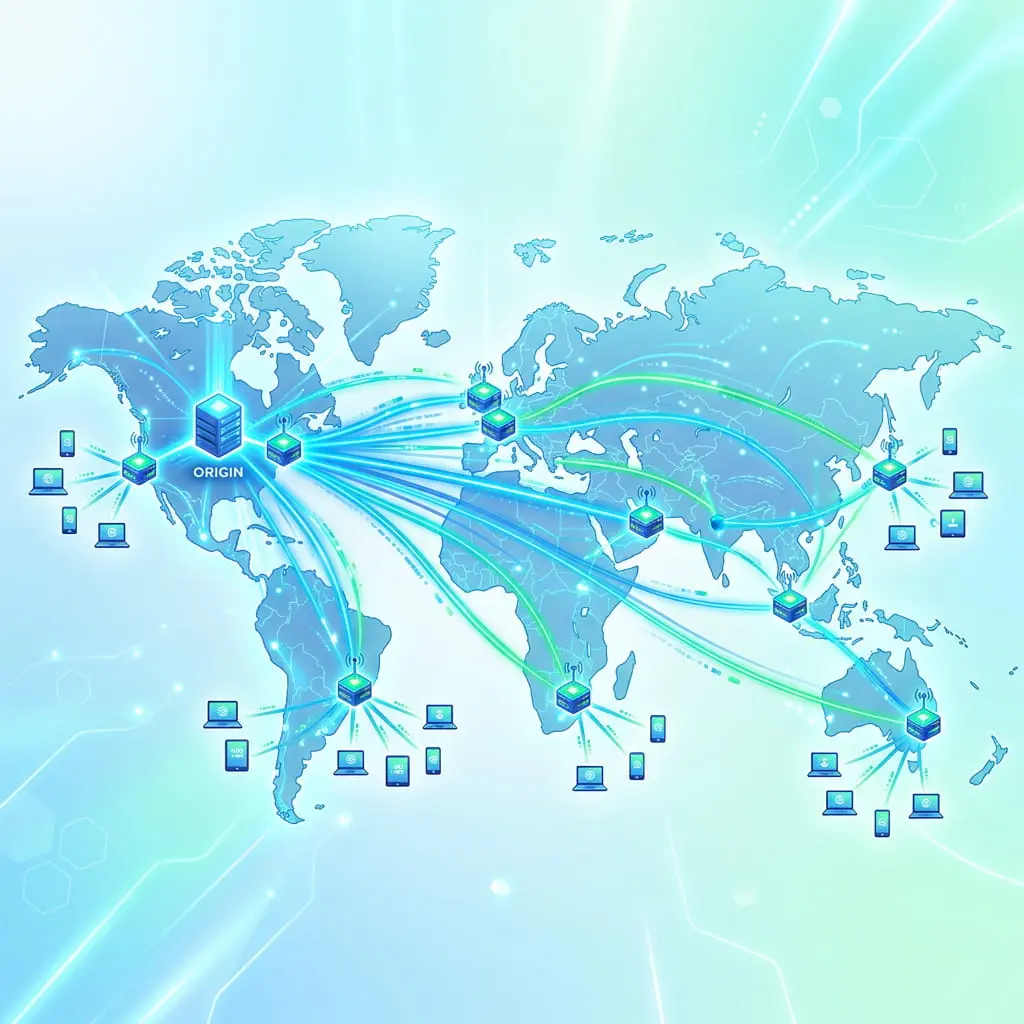
But during a major event like a World Cup, the challenge is not just distribution. It is simultaneity.
When millions of people connect at the same time to watch the same content, the systems have to absorb a brutal and sudden demand spike. It is not traffic distributed throughout the day — it is a massive volume concentrated in a two-hour window. Operators talk about spikes of several terabits per second circulating simultaneously across their networks. To put it in perspective, that is equivalent to billions of web pages loading at the same time.
And the complexity does not end at distribution.
Before the video reaches the user, it has gone through several processes in the central infrastructure. The content captured at the stadium is transcoded in real time into multiple resolutions, from 4K to 360p, to adapt to the connection speed of each device. It is segmented into fragments of a few seconds that allow the player to dynamically adapt quality. It is encrypted to comply with licensing agreements. And it is delivered to CDN nodes so that it is available as close as possible to the end user before they request it.
All that processing happens in data centres working under extreme pressure during the event.
Here a factor that often goes unnoticed appears: energy.
Real-time video transcoding is one of the most computationally intensive operations that exist. Simultaneously processing millions of streams in multiple formats and qualities requires enormous GPU capacity. During a world-scale event, the energy consumption of the streaming infrastructure shoots up dramatically. Operators have to size their capacity to absorb the peak, which means keeping resources available that under normal conditions remain on standby.
And artificial intelligence is adding an additional layer of pressure. Modern streaming systems already use models to predict demand before it occurs, to pre-position content on the most suitable nodes, to optimise video quality based on each user's network conditions, and to detect playback issues in real time before the user notices them. Each of these capabilities demands more computing power, more data, and more infrastructure.
But what makes an event like the World Cup unique is not just the volume. It is the intolerance for failure.
In a football match, there is no degraded mode. If the stream cuts out in the 90th minute, in the extra time of a final, the impact is immediate and visible to millions of people at the same time. That is why operators design their infrastructures with redundancy at every layer: multiple stream ingest sources, real-time replication between regions, automatic failover capability, monitoring systems that detect incidents in seconds, and contingency plans for worst-case scenarios.
It may seem that watching a match on your mobile phone is simply opening an app. But behind that apparent simplicity lies a global infrastructure operating under a pressure that few industries know.
When the entire world watches the same goal in the same second, there are thousands of servers, hundreds of distribution nodes, private low-latency networks, and engineering teams working to ensure that moment arrives on time. An infrastructure that cannot fail, precisely when the most people are using it at once.
And at the centre of that operation, as in so many other industries, there is no app. There are data centres, critical infrastructure, and increasingly, a layer of intelligence designed to ensure no goal is lost along the way.