
Global digitalization is advancing at an accelerated pace, driven by technologies such as cloud computing, artificial intelligence, the Internet of Things (IoT), and process automation. This exponential growth of data presents a major challenge: will large data centers be able to handle this entire load in a sustainable and efficient manner?
Although large data centers have become the backbone of the digital ecosystem, they face significant energy, operational, and environmental challenges that cast doubt on their ability to sustain global digitalization indefinitely. Let's explore the limitations of these giants, the resource consumption they require, the growing role of BRICS countries (Brazil, Russia, India, China, South Africa), and why a decentralized infrastructure could be the future of the industry.
Growth of Hyperscale Data Centers: How Far Can They Go?
Hyperscale data centers, operated by tech giants such as Amazon Web Services (AWS), Google Cloud, Microsoft Azure, and Meta, have grown exponentially over the last decade. According to a report by Synergy Research Group, the number of large data centers surpassed 1,000 in early 2024, with an expected addition of 120 to 130 new facilities each year.
As digitalization progresses, the total capacity of data centers is expected to triple by 2030, largely due to the adoption of artificial intelligence and machine learning technologies, which require enormous processing power.
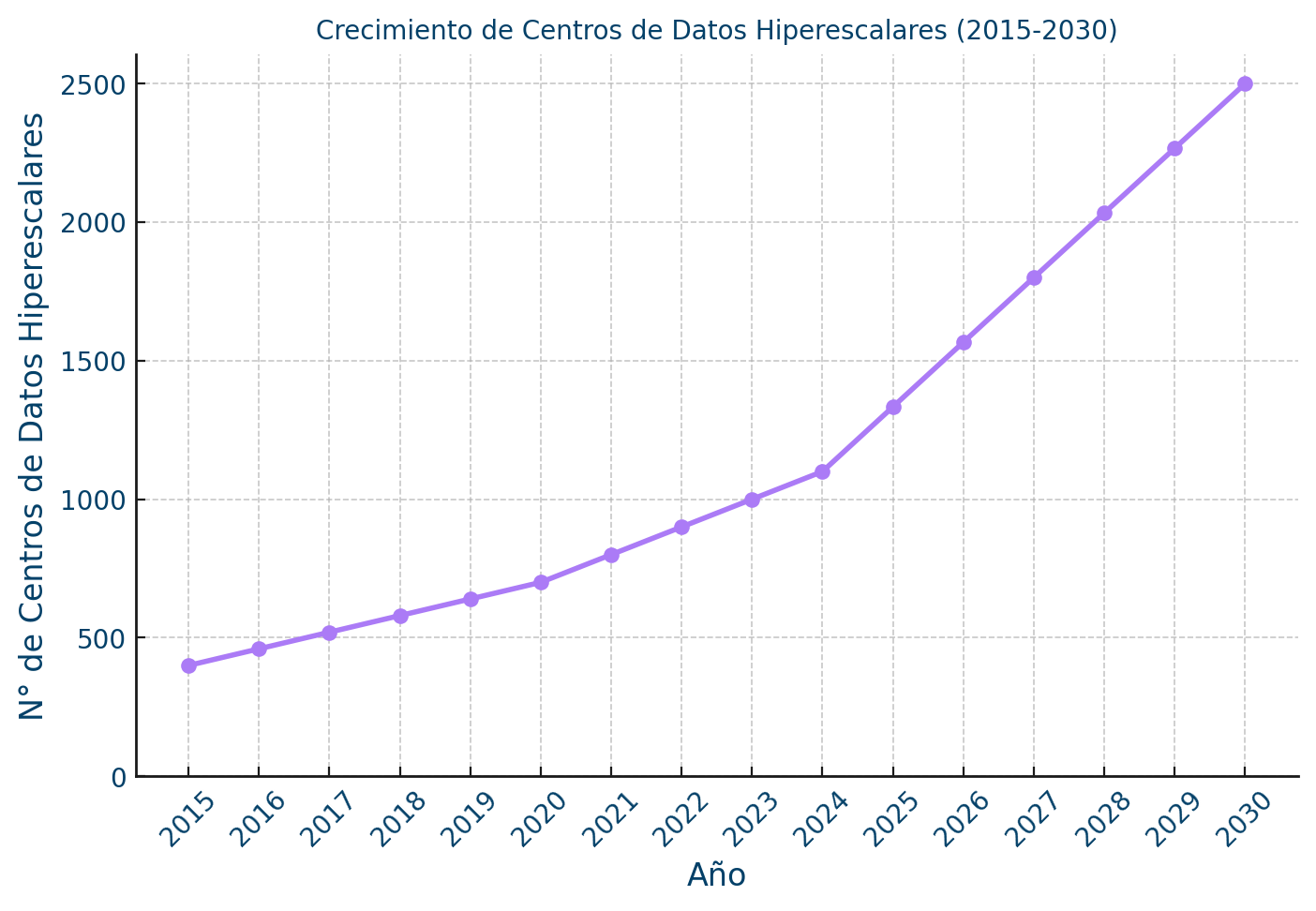
However, this growth comes at a cost: the physical infrastructure and the consumption of energy and water resources are reaching concerning and unsustainable limits.
The energy problem: Will there be enough electricity for everyone?
The rapid growth of data centers has raised concerns about their impact on global energy demand. According to Gartner, by 2027, energy consumption of AI-powered data centers will increase by 160%, and 40% of these centers could face operational limitations due to insufficient energy supply.
Current Consumption and Future Predictions
En 2022, los centros de datos a nivel mundial consumieron alrededor de 460 teravatios-hora (TWh), lo que representó aproximadamente el 2% del consumo eléctrico global.
Se estima que, para 2030, este consumo se triplicará, lo que supondrá entre el 6% y el 8% del consumo total de electricidad a nivel mundial.
Para ponerlo en contexto, el sector de los centros de datos consumirá más energía que el Reino Unido, Alemania y Francia juntos.
In addition to electricity consumption, data centers also generate massive heat waste, requiring the implementation of costly cooling systems that further increase energy expenditure. In some regions, restrictions on electricity supply have begun to slow down the expansion of these giants.
Energy scarcity in the Netherlands, a real example.
In Amsterdam, the rapid growth of data centers led the government to freeze the construction of new infrastructure in 2019 due to insufficient energy supply. Companies like Microsoft and Google had to rethink their expansion projects due to the lack of available electricity in the region.
In Amsterdam, the rapid growth of data centers led the government to freeze the construction of new infrastructure in 2019 due to insufficient energy supply. Companies like Microsoft and Google had to rethink their expansion projects due to the lack of available electricity in the region.
The water problem: Massive cooling and resource scarcity
In addition to their high energy consumption, hyperscale data centers require large amounts of water for cooling.
Un centro de datos medio de 100 MW puede consumir más de 1 millón de litros de agua al día para enfriar sus servidores.
En regiones secas o con estrés hídrico, este consumo compite directamente con el agua destinada al uso humano y la agricultura.
En Aragón, la expansión de los centros de datos de Amazon implicaría un consumo anual de agua equivalente al de una ciudad de 20.300 hogares.
The growing need for water has led some governments to question the viability of continuing to build data centers in areas vulnerable to climate change.
The impact of the BRICS on the data center market and energy consumption
The BRICS countries (Brazil, Russia, India, China, and South Africa) are playing an increasingly important role in the global expansion of data centers, leading to a considerable increase in the demand for energy and resources.
Accelerated Growth of Digital Infrastructure in the BRICS
China está invirtiendo masivamente en centros de datos y energías renovables, liderando el desarrollo digital en América Latina y otras regiones.
India está construyendo nuevas infraestructuras para convertirse en un hub digital global, con inversiones masivas en centros de datos.
Brasil, Rusia y Sudáfrica están incrementando gradualmente su capacidad, con inversiones en soluciones sostenibles.
Impact on global energy consumption
Según la Agencia Internacional de la Energía (AIE), los centros de datos consumieron 460 TWh en 2022, pero esta cifra podría superar los 1.000 TWh en 2026, con un alto porcentaje del crecimiento proveniente de los BRICS.
La necesidad de energía limpia ha llevado a estas naciones a apostar por contratos de renewable energy purchase to reduce their environmental impact.
While the BRICS are contributing to digital growth, they are also significantly expanding resource consumption, which increases pressure on global energy infrastructures.
Decentralization as an alternative: Modular data centers and Edge Computing
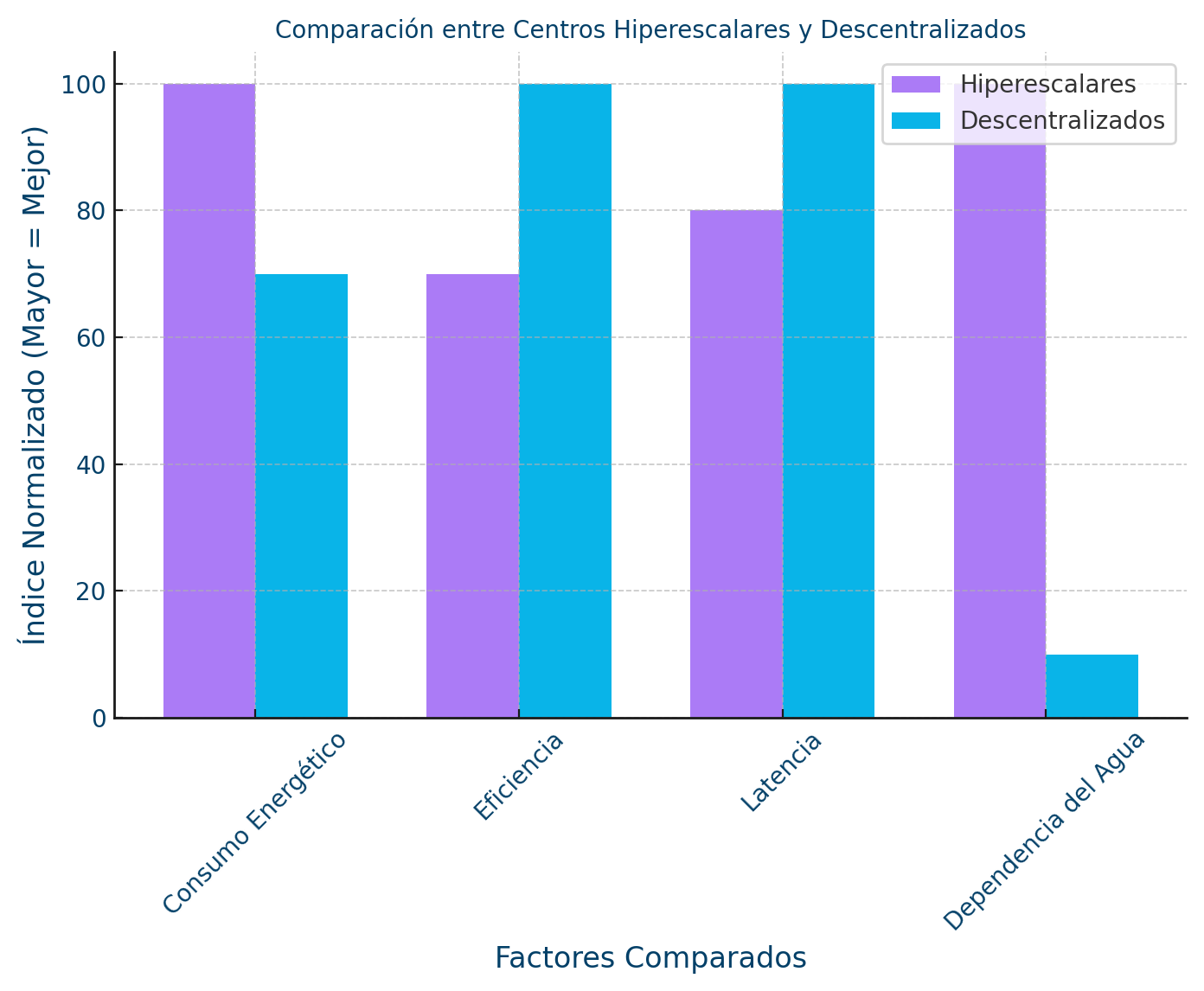
Given that large data centers are reaching their sustainability limits, the decentralization of technological infrastructure emerges as a viable alternative for the future of digitalization.
Modular data centers and Edge Computing offer several advantages:
Menor consumo de energía: Hasta 30% más eficientes que los hiperescalares.
Ubicación estratégica: Más cerca de los usuarios, reduciendo la latencia.
Menos dependencia de agua: La refrigeración líquida puede reducir el consumo hídrico en un 90%.
Mayor adaptabilidad: Expansión modular y flexible según la demanda.
What lies ahead?
The uncontrolled growth of hyperscale data centers is not sustainable in the long term.
Market trends indicate that major operators will begin to diversify their infrastructures and opt for hybrid models that combine traditional data centers with Edge Computing and modular solutions.
Additionally, advancements in low-power chips, 5G networks, and distributed processing are expected to help mitigate the energy crisis in the sector. However, the key will be to find a balance between efficiency, sustainability, and infrastructure demand.
Digitalization is unstoppable, but relying solely on hyperscale data centers is not viable. It is time to rethink the model and build a more sustainable technological future.
Keep this in mind
Large data centers have been fundamental in digital transformation, but their unchecked growth is clashing with physical and environmental limits. The energy crisis, water scarcity, and the challenges in continuing to expand them cast doubt on their viability as the sole solution for global digitalization.
To ensure a sustainable technological future, it is crucial to adopt a more decentralized approach, supported by modular data centers, Edge Computing, and more efficient technologies.
The future of data cannot rely solely on energy-inefficient mega structures. It is time to innovate and build a balanced, efficient, and environmentally friendly digital infrastructure.