
Last November, we had a meeting with clients in Argentina that allowed us to conduct a thorough and collaborative analysis of the Data Center market in the country.
In this session, which involved operations managers from sectors such as Telecoms, Colocation, and Banking, significant conclusions were drawn that reflect the current state and challenges of the sector. This report aims to reflect on these conclusions, develop an analysis that connects various critical points, and provide relevant data, including inputs and outputs, to offer a clear perspective for decision-making.
The Data Center Market in Argentina
Growth Plans in Colocation, Telco, and Banking: Where is the Demand Increase Coming From?
- Colocation: The digitalization of businesses is driving a growing demand for colocation services, especially for solutions that integrate data storage and connectivity. Additionally, there is a rising interest in offering private clouds as differentiated products by colocation providers, as they have the knowledge and capacity to incorporate these products into their portfolios. Another expected growth avenue is the hosting of third-party clouds, creating a comprehensive offering.
- Telco: Telecommunications are rapidly expanding in Argentina, particularly in mobile connectivity and fiber optics. This market is also being driven by the acquisition of medium and small ISPs by large operators, consolidating the offering and improving national coverage. The demand arising from the increase in devices connected to the internet presents a clear challenge for operators in terms of coverage, availability, and bandwidth.
- Banking: The financial sector is undergoing a digital transformation that includes the growth of online banking, the adoption of embedded finance, and the open banking model, all of which drive a greater demand for secure and scalable technological infrastructure.
Projects in Development
The projects shared during the meeting highlight significant advancements, with one of the key areas being the retrofit of base stations with an edge philosophy, which opens the door to advanced technologies such as AI and 5G, addressing needs in remote areas.
Investments and New Projects Already Announced in the Market
- Claro Argentina: Data center Tier III en Buenos Aires (2024-2026), con 30 millones de dólares de inversión inicial y diseño de alta disponibilidad.
- G2K: Development of a 3,000 m² Tier III data center, positioned as one of the most advanced in the region.
- Oracle: Evaluation of a 100 million dollar investment, focused on data sovereignty and reduced latency.
- Cirion: Expansion of capacity by 1.5 MW and exploration of a new site in the Buenos Aires area.
- Province of Buenos Aires: The provincial government inaugurated its first data center, consolidating its commitment to technological modernization and improving digital services for citizens.
Reflections:
While the opportunities are clear, economic conditions and the lack of political stability represent the main challenges, considering that investments in Data Centers have a lifespan of 20-30 years. Regional investments in countries like Brazil and Chile highlight a competitive market where Argentina must consolidate its value proposition.
Impact of Artificial Intelligence on the Data Center Market
Effects of AI on Infrastructure
1.Resource Demand:
- AI is transforming storage and processing needs, requiring high-density servers and robust energy capabilities.
- Global projections indicate a consumption of 18 GW by 2028, highlighting the importance of preparing adequate infrastructure.
2.Technological Infrastructure:
- Low-latency networks and specialized hardware such as TPUs are now essential.
- The use of liquid cooling is positioning itself as a critical solution to manage the heat generated by AI workloads.
Ventajas:
Clima: Las temperaturas bajas de la Patagonia argentina son ideales para contribuir con una baja del consumo de energía que se invierte en refrigeración.
Espacio: Las provincias patagónicas ofrecen vastas extensiones de terrenos deshabitados, ideales para construir las instalaciones de gran escala y sin interferencias que requieren los data centers.
Acceso a fuentes de energía y a bajo precio (10 céntimos de dólar KW):
Se dispone de fuentes como petróleo y gas, hidroeléctrica, nuclear incluso
condiciones para parques eólicos y solares a gran escala, entre otras.
Conectividad: Cable submarino en las toninas y Chile lo que permitiría baja latencia, faltaría por mejorar un poco la conectividad interna de 4g, 5g y fibra.
Condiciones económicas y comerciales: indicadores como rigi, apertura económica para importar equipamiento, descenso de la inflación hace ser optimistas aunque se necesitan políticas estables a largo plazo.
Talento humano: Argentina es valorada en el mundo por su creciente población de profesionales altamente capacitados en ciencias informáticas, ingeniería de software y campos afines a la IA; egresados de universidades de renombre y con un destacado nivel de inglés.
Energy Consumption, How AI Affects It
Currently, AI requires 4.3 GW of power from data centers, and this is expected to increase to 18 GW by 2028. By that year, AI workloads are estimated to account for between 15% and 20% of the total energy consumption of data centers. This means that these facilities must adapt to effectively and sustainably meet the energy needs of AI-driven applications.
Sustainability in the Sector, How to Mitigate the Impact of Increased Consumption.
Currently, KPIs are not being measured in national companies. However, companies listed on stock exchanges in the USA or Europe are beginning to implement them.
The new law in Argentina states that 20% of energy consumption for loads mayores a 300 kw, must come from renewable sources, b, the penalties for non-compliance are low, which limits their effectiveness. It is essential to promote tax incentives and training programs to achieve a real impact.
Reflections:
While the data provided by the market aligns with the previous points, the reality is that there is currently no pressure on Data Centers in Argentina. The maximum capacity being requested in the country today is 8 kW per rack, which is still far from the figures seen when discussing infrastructure related to AI processes. This doesn’t mean that such demand won’t arrive, and the market must be prepared. What it indicates is that we need to be cautious with the figures presented by the sector and seek ways to have scalable infrastructure with highly versatile designs that can adapt to the evolving service requirements.
While the mentioned advantages are real, there are some concerns:::
- Last-Mile Connectivity (electric and telecommunications): There is significant backbone distribution of fiber and electricity, but due to the vast size of the country, there is a lack of connectivity to reach remote areas away from the main backbone.
- Doubts about whether the AI business justifies the entire investment in site infrastructure, as well as the electrical and networking distribution required to make it viable.
- If rack power values reach 100 kW, is there cooling technology that can support the associated heat dissipation? What happens if all or part of the cooling system fails? Thermal inertia would make it very difficult to return to operational temperatures, and the equipment would be at high risk.
Use of AI in Data Center Operations
Inputs and Outputs: What AI Can Contribute
A lot is said about what AI will mean for the infrastructure of Data Centers, however, little is discussed about what it can do to optimize day-to-day operations, analysis, prediction, or process automation.
To be much more specific, we did an exercise, starting by identifying the data provided by the Data Center infrastructure, which we have called inputs, and envisioning the useful information or recurring tasks where AI can help us become more efficient and effective. Ultimately, we looked at how AI can help us minimize risks, increase revenue, and reduce costs.
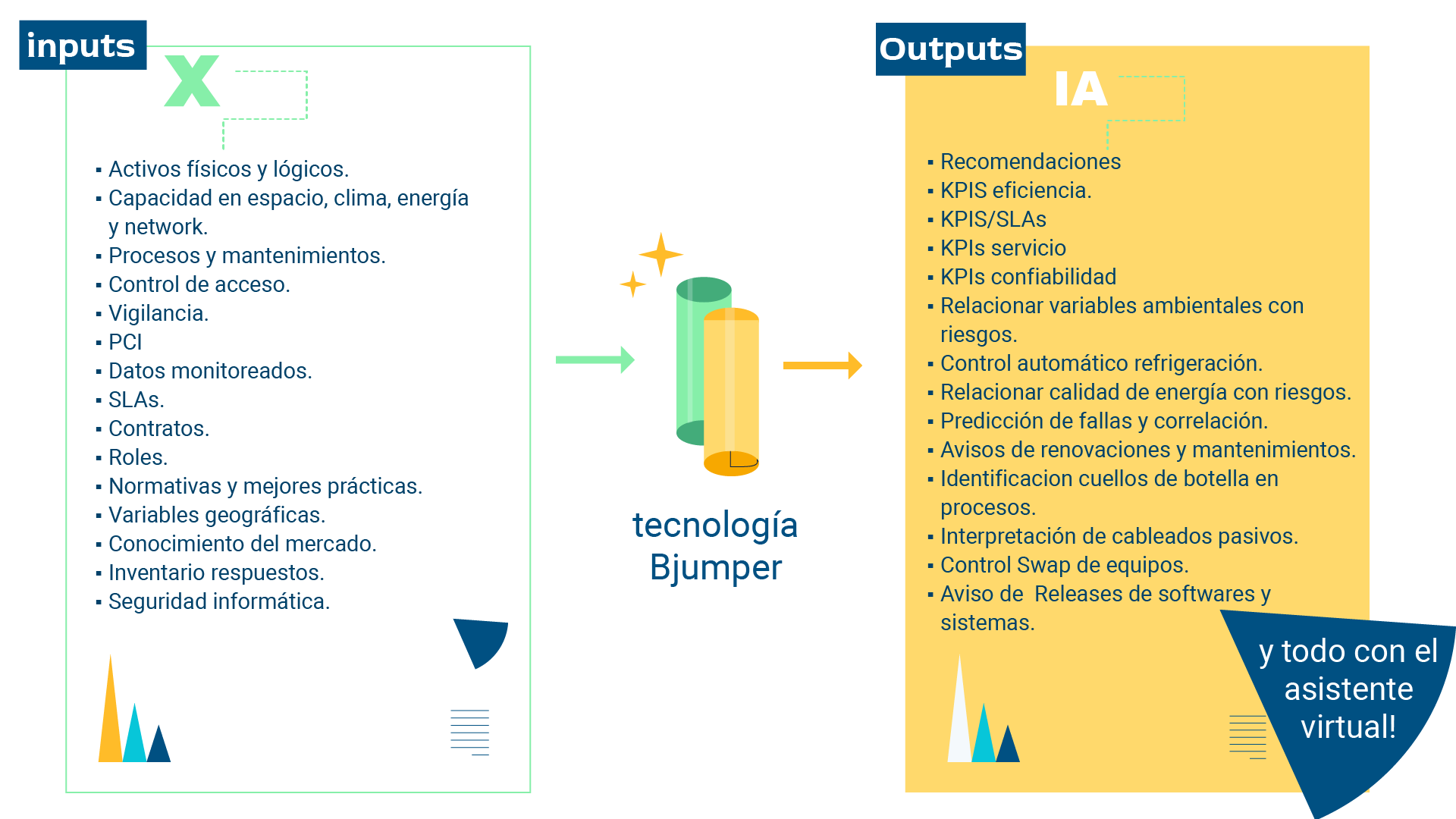
And if there was one thing all participants agreed on, it is that the interface needs to be simple and the information should be presented in a language that can be understood by various departments, regardless of their technical knowledge. Currently, the vision is to have a virtual assistant that allows users to ask questions in a natural way.
Reflection:
The application of AI in Data Center operations not only ensures greater operational efficiency but also allows for anticipating issues before they occur, improving reliability and reducing long-term costs. This integrated approach is also key to incorporating sustainability as a strategic focus, transforming the way resources are managed.
Final Notes:
1. Consolidating Infrastructure: Invest in last-mile connectivity and sustainable energy solutions.
2.Driving AI: Promote the adoption of advanced technologies that enable Argentina to position itself as a regional hub.
3. Attracting Investments: Create incentives that promote the development of local projects and attract foreign capital.
4. KPIs and Regulations: Develop tools to measure the sustainability and efficiency of Data Centers in a standardized way.
Next Steps:
Bjumper will continue integrating AI into its products to ensure full automation and a competitive future for its clients. The data and insights presented here mark the first step toward building a robust, sustainable sector ready to face tomorrow's challenges together. 🚀