
For years, the Middle East was seen as a transit point for data. An invisible bridge between continents. Europe spoke to Asia through it, Africa connected to the world by relying on its cables, and thousands of companies trusted that this network—silent and buried—would simply keep working.
But in recent weeks, something changed.
The region’s digital map—the one that rarely appears in the news—began to resemble a military map far too closely. In Dubai, Abu Dhabi, Bahrain, Tel Aviv or Riyadh, there are not only skyscrapers and financial centres. Beneath those cities, or in windowless buildings on their outskirts, reside some of the systems that sustain the global economy. Data centers belonging to Amazon, Microsoft, Google or Oracle. Infrastructures designed to withstand fires, power failures, even natural disasters.
What they were not designed to withstand was a modern war.
The first days of the conflict did not seem different from other episodes of tension in the region. Missiles, drones, exchanged statements. But at some point between the first and third day, someone made a different decision—the targets changed.
They were no longer just military bases or visible infrastructure. Something quieter began to be hit. In the United Arab Emirates, two AWS facilities were struck by drones. They were not massive or spectacular attacks; they were precise, enough to cause damage without the need to completely destroy the building. In Bahrain, a nearby explosion affected another facility. Inside those buildings, the effect was immediate.
First, the loss of power. Then, the emergency systems. Generators starting up, UPS systems absorbing spikes, automatic attempts to isolate the damage. And then, the unexpected enemy: the fire suppression system itself. Water released to save the infrastructure… and at the same time damaging racks, cabling, equipment.
For a few minutes, perhaps hours, the perfect architecture of redundancy ceased to be so.
Because the theory says that everything is duplicated. That there is always another zone, another region, another path. But that theory does not account for multiple points failing at the same time due to a coordinated cause. And that is exactly what happened.
Outside the data centers, no one saw flames. There were no viral images. But on the screens of thousands of engineers around the world, alerts began to appear. Degraded services, latency spikes, instances that did not respond.
In the region’s banks, some systems stopped processing payments. Digital platforms began to fail. Applications used daily by millions of people—transport, payments, services—started to behave erratically. It was not a total blackout; it was something more unsettling. A progressive degradation. As if the cloud, little by little, were beginning to unravel.
Over the following days, the pattern repeated. Not always with direct impacts, but with enough pressure to maintain constant uncertainty. Drone activity near critical facilities, intermittent interruptions, incomplete recoveries. The problem was no longer the initial damage—it was the impossibility of returning to a stable state. Each recovery attempt was made under the threat of a new attack. Each restored system could fall again. And in that context, even the most robust elements began to show their limits:
Energy
Data centers are prepared for power cuts. They have batteries, generators, redundancy. But all of that is designed for isolated failures, not for an environment where the power grid itself can be a continuous target. In some cases, generators worked. In others, the issue was not starting them, but maintaining the fuel supply or preventing the surrounding environment from making them vulnerable again.
Water
In a region where water is already a critical resource, cooling systems depend on a complex chain that includes desalination plants, transport and storage. No one directly attacked those systems in the first days, but it was enough to see what was happening for an uncomfortable question to arise.
What would happen if they did?
Meanwhile, beneath the sea, another layer of uncertainty remained intact… for now.
The submarine cables connecting the region to the rest of the world were not cut during these first fifteen days. But key projects began to be delayed. Maintenance operations became more complicated. And the points where those cables come ashore—the landing stations—began to be seen in a new light. They are few, they are known, and they are vulnerable.
The global system continues to function, but it no longer seems as solid as before.
What happened in those first fifteen days was not a collapse. It was something more important—it was a demonstration that it is vulnerable.
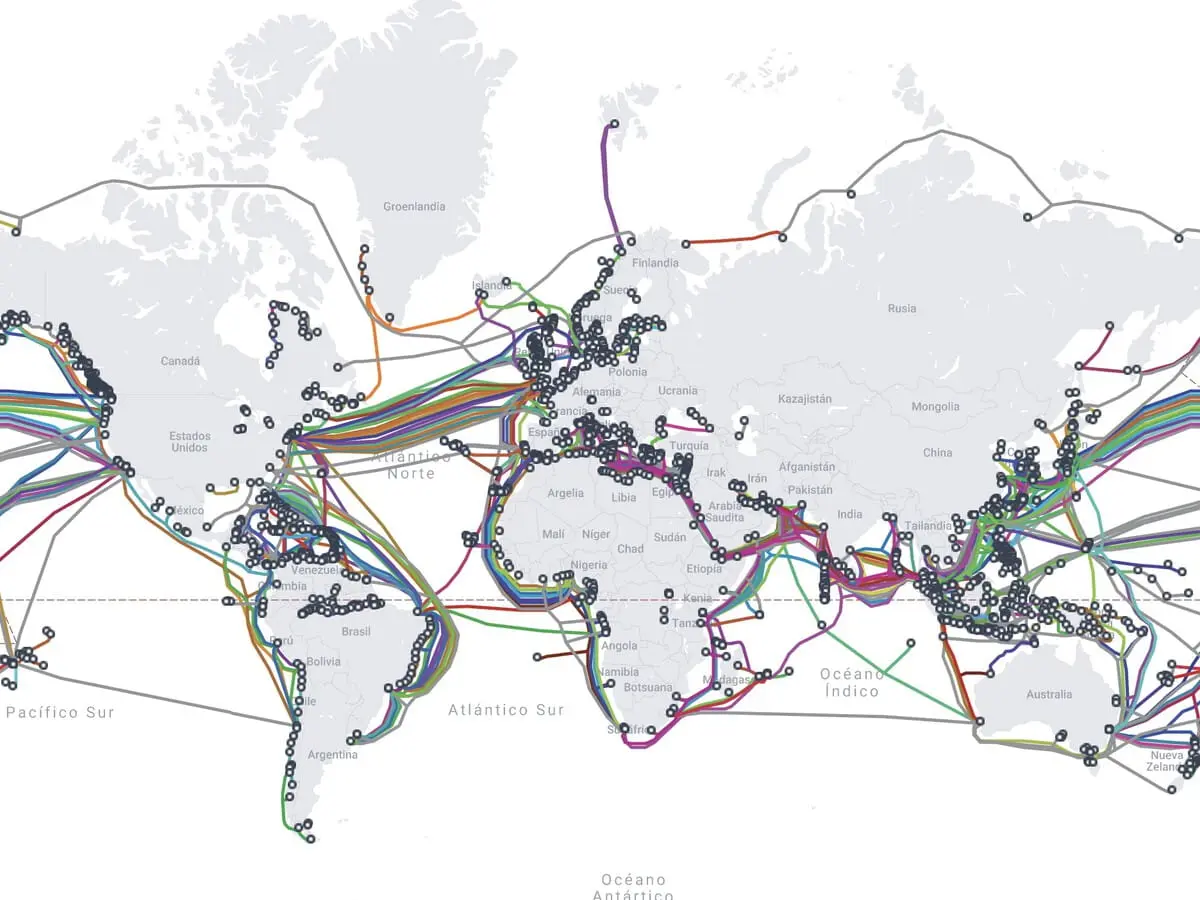
For the first time, cloud infrastructure,that which for years has been presented as abstract, distributed, almost intangible,revealed itself for what it really is: physical, localised and vulnerable. And, above all, relevant from a military point of view. Because in the end, behind every digital service there is a building. Behind every building, an electrical connection. And behind every connection, a strategic decision.
Thousands of kilometres away, in Europe, in Asia, in America, many companies began to review something that until then had seemed like a formality: their contingency plans. Moving workloads to other regions, activating redundancies that had never been tested under real conditions, and accepting higher latencies in exchange for stability.
Traffic began to shift towards Frankfurt, Ireland, other “safer” areas. But that word safe was beginning to lose its meaning.
Because if these first fifteen days made anything clear, it is that war is no longer fought only on land, sea or air. It is also fought in the places where data resides and those places, until now invisible, have ceased to be so.
In the next chapter of this series, we will see what happens when the conflict ceases to be an initial shock and becomes sustained pressure. When attacks cease to be incidents and become part of a strategy. And then the question will no longer be whether data centers can fall, but how long they can hold out.
Sources
Wired (2026) — attacks on AWS data centers in the Middle East
DataCenterDynamics (2026) — disruptions in cloud regions in the region
AP News (2026) — physical vulnerability of cloud infrastructure
PwC — growth of the data center market in the Middle East
AWS — deployment of cloud regions in the Middle East