
The energy demand of data centers keeps growing. And the industry is looking for solutions that, until recently, seemed like science fiction.
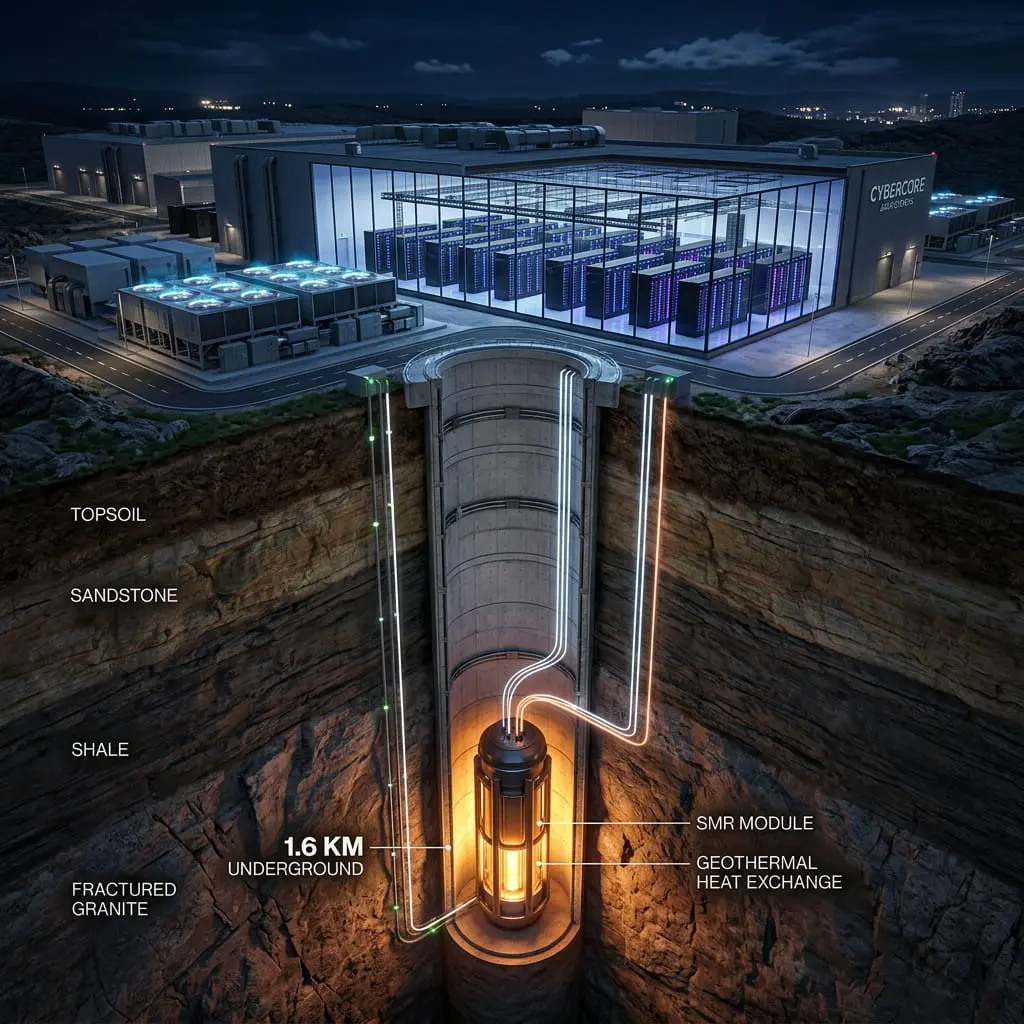
A Californian startup called Deep Fission has just proposed something worth paying attention to: burying nuclear reactors one and a half kilometers underground to power digital infrastructures. No large concrete domes, no massive containment structures — the earth does that job.
The physics behind the idea
Conventional pressurized water reactors need to keep the coolant liquid above 300°C, which requires pressures of 150–160 atmospheres and steel vessels of enormous cost. Deep Fission's proposal is elegant: at 1.6 km depth, the water column exerts that pressure naturally and completely for free.
The rock surrounding the borehole acts as a containment shield. Result: up to 70% less concrete and steel compared to a conventional plant.
And the technology to drill the borehole doesn't need to be invented — the oil and gas industry already has it, proven, available, and with mature supply chains.
The reactor by the numbers
The "Gravity" module fits in a 76 cm diameter borehole, generates 15 MW of electricity from 45 MWt of heat, and uses standard low-enriched uranium fuel.
Here's the figure that stands out most: a single borehole is 15 MW, but 100 boreholes at the same site add up to 1.5 gigawatts. All that power with equipment the oil industry already has sitting in a warehouse somewhere.
What does the regulator say?
It's not just an idea on paper. The U.S. Nuclear Regulatory Commission (NRC) is already conducting pre-application activities with Deep Fission, within the framework of a combined license application for its DFBR-1 reactor.
Furthermore, in March 2026 the NRC published new licensing regulations, known as "Part 53," with the aim of making the authorization process for advanced reactors faster, more flexible, and more cost-effective, effective from April 29, 2026. It is the first regulatory change of this magnitude in decades, and it comes at just the right time.
Deep Fission is also part of the U.S. Department of Energy's Reactor Pilot Program, created by executive order in May 2025 to accelerate the deployment of test reactors.
The context that explains everything
In 2022 alone, data centers accounted for 1% of global energy consumption, and are estimated to exceed 3% by 2030. A single data center can need more than 100 MW of electrical power — the equivalent of a city of 200,000 inhabitants.
Big tech companies promised for years to operate 100% on renewables. Today they look at nuclear with different eyes. AI doesn't wait, and its real limits are not software ones, but energy and physical infrastructure and renewables alone can't keep up.
The open questions
It would be irresponsible not to mention it — the technology faces significant challenges ahead.
Nuclear regulatory cycles typically take between 5 and 10 years, and such an unconventional design requires solid engineering evidence, not just theory: access for inspection, component replacement, thermal dissipation, and incident response are questions that still lack definitive answers.
Deep Fission currently has a 6,000-foot data borehole in Kansas, $40 million in recent public funding, and a series of letters of intent that don't commit anyone. As engineering, the argument is solid. As a power plant, it remains a very deep borehole and a very good proposal.
What this tells us about the sector
At Bjumper we have been working with critical data infrastructures for years. We know that energy is not an operational detail, it is the foundation on which everything else is built.
What makes Deep Fission interesting is not just the technology itself. It's what it represents: the convergence of the energy industry, geological engineering, and digital demand is generating solutions that break with 60 years of paradigms.
The concrete dome was the image of the 20th century. Perhaps the borehole will be that of the 21st. Or perhaps space. We keep exploring where the next data center will be.
Do you see this as a real solution or still too risky?
Sources: Xataka (Nov. 2025) · Renovables Verdes (Jun. 2026) · U.S. Nuclear Regulatory Commission · American Action Forum (Apr. 2026) · Data Center Market (Mar. 2025) · autonocion.com (Jun. 2026)